Melasma often looks like a simple collection of dark patches, but treating it well is rarely as simple as picking a cream or booking a laser session. The pattern, the depth of the pigment, your triggers, your skin tone and how your skin responded to earlier treatment all influence what a dermatologist is likely to recommend.
This guide to melasma treatment in Chennai explains what melasma is, why it appears, how it is assessed, which treatments are used and when procedures may help. It also covers timelines, recurrence, cost factors and how to choose a clinic.
What Is the Best Treatment for Melasma?
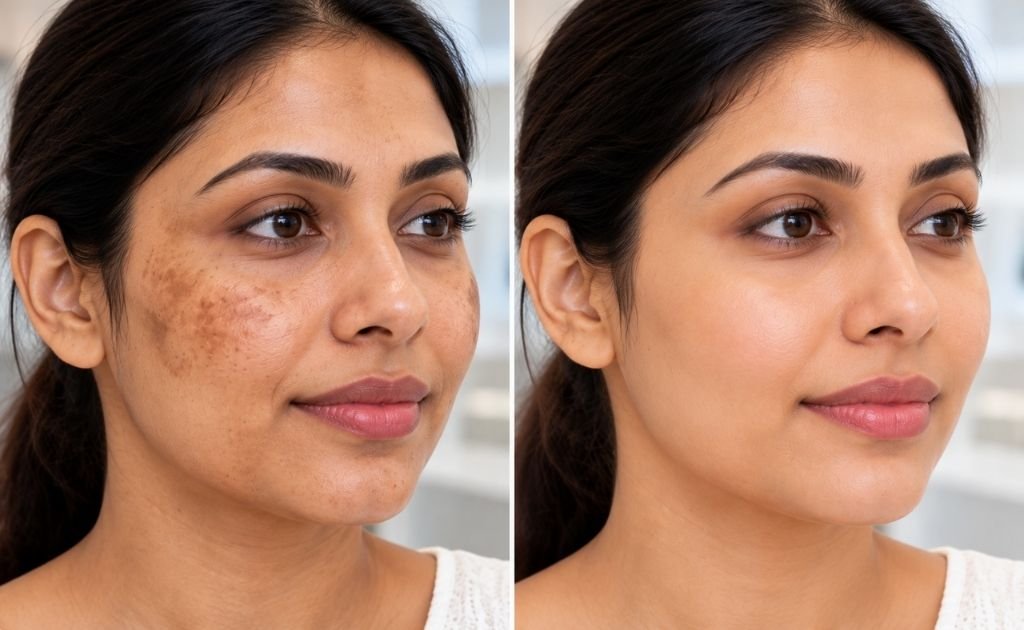
There is no single best treatment for everyone. A dermatologist may combine sun protection, topical medication and, when appropriate, procedures such as chemical peels or selected laser and light treatments. The plan depends on the type of melasma, skin tone, pigment depth, triggers and how the skin responds. The American Academy of Dermatology’s melasma treatment guidance describes the same approach: sun protection plus medication applied to the skin, and sometimes a procedure.
What Is Melasma?
Melasma is a common pigmentation condition in which brown or grey-brown patches develop on the skin, most often on the face. Typical areas are the cheeks, forehead, bridge of the nose, upper lip and chin. In many people the patches appear on both sides of the face in a roughly symmetrical pattern.
It is not contagious and not harmful to physical health, but it can last for years and usually becomes more noticeable after sun exposure. It is more common in women, though men develop it too.
Is Melasma the Same as Normal Pigmentation?
No. Not every dark patch is melasma. Several conditions look similar and have different causes, which is why they are not all treated the same way.
| Melasma | Other pigmentation |
|---|---|
| Often symmetrical patches on the face | May be isolated spots or uneven areas |
| Commonly influenced by sunlight and hormones | May follow acne, injury, irritation, medication or sun exposure |
| Frequently recurs | Recurrence depends on the cause |
| Usually needs long-term management | Treatment depends on the underlying condition |
Post-inflammatory hyperpigmentation (marks left after acne or a rash), sun spots, freckles, drug-related pigmentation and certain birthmark-type conditions can all resemble melasma. A treatment that suits one of these can be unhelpful, or even irritating, for another. Diagnosis therefore comes before choosing a laser, a peel or a cream.
What Causes or Triggers Melasma?
No single factor explains melasma in every person. It usually reflects an underlying tendency combined with one or more triggers:
- Sunlight. Ultraviolet exposure is the most consistent trigger and the most common reason patches darken again.
- Visible light. Ordinary visible light can also worsen melasma, particularly in darker skin tones.
- Hormonal influences. Pregnancy, oral contraceptive pills and hormone therapy are associated with melasma in some people.
- Family tendency. Many people with melasma have a relative who also has it.
- Certain medications and scented or irritating skincare products.
- Stress, which is considered a possible trigger.
- Heat and skin irritation, which may aggravate pigmentation in some people.
Chennai’s strong sunlight and year-round outdoor exposure, from commuting to weekend errands, make daily photoprotection especially relevant for anyone managing melasma here.
Why Melasma Can Be Difficult to Treat
Melasma pigment can sit in the upper layer of the skin (epidermal), in the deeper layer (dermal) or in both (mixed). Mixed melasma is the most common form. Superficial pigment generally responds better to treatment; deeper pigment tends to respond slowly and only partially.
Several other things add to the difficulty. Triggers such as sunlight are ongoing. Skin responses differ from person to person. Irritation from harsh products or over-aggressive procedures can make pigmentation darker rather than lighter. For these reasons treatment takes time, and some form of maintenance is usually needed afterwards.
How Dermatologists Assess Melasma
Visual examination
Melasma is usually diagnosed by looking closely at the skin: the colour, borders and distribution of the patches.
Skin history
Expect questions about sun exposure, pregnancy or hormonal treatment, current medications, skincare products, any irritation, and which pigmentation treatments you have already tried and how your skin reacted.
Specialised examination
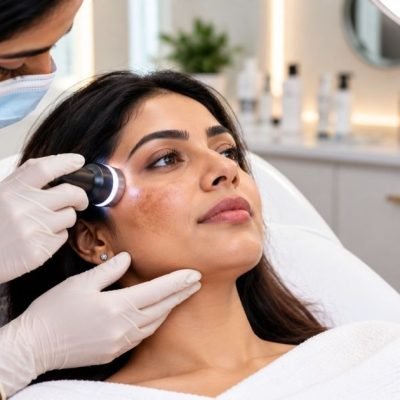
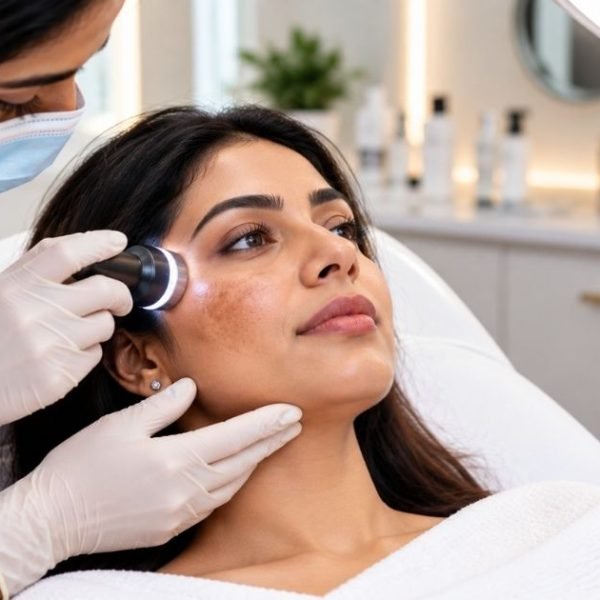
Depending on the case, a dermatologist may use a Wood’s lamp or a dermatoscope to judge how deep the pigment extends. Not everyone needs these tools. A skin biopsy is occasionally done when another condition has to be ruled out, but it is not routine.
The consultation should end with a plan that explains what is being recommended, in what order, and why.
Melasma Treatment Options
1. Sun protection
Photoprotection is the foundation of every melasma plan. Without it, other treatments tend to underperform. The AAD’s melasma sun-protection guidance recommends a broad-spectrum, water-resistant sunscreen of SPF 30 or higher, reapplied every two hours when outdoors, along with shade, a wide-brimmed hat and sunglasses.
Because visible light can worsen melasma, a tinted sunscreen containing iron oxide is often suggested, particularly for darker skin tones. Gentle, fragrance-free skincare matters too: a product that stings or burns is one to stop using and mention to your doctor.
2. Dermatologist-guided topical treatment
Topical medication is usually the first active treatment. Depending on the assessment, a dermatologist may select hydroquinone, tretinoin, a triple-combination cream (hydroquinone, tretinoin and a mild corticosteroid), azelaic acid, kojic acid, vitamin C or other agents. For melasma that does not respond, some dermatologists consider tranexamic acid after reviewing the patient’s medical history.
These are medicines with specific durations and side-effect profiles. They should be used only as prescribed and reviewed at follow-up, never self-started or continued indefinitely on your own.
3. Chemical peels
Selected superficial peels may be added to help topical treatment work better. Peels are not suitable for everyone. Because any procedure that inflames the skin can worsen pigmentation, the peel type, strength and spacing are chosen cautiously, and the skin is usually prepared beforehand.
4. Laser and light-based treatments
Laser and light procedures can be considered in selected patients, generally as an addition to sun protection and topical care rather than a starting point. DermNet’s melasma treatment information notes that peels and lasers carry a risk of worsening melasma or causing post-inflammatory hyperpigmentation, and that relapse after device-based treatment is common. Heat is one reason: it can stimulate pigment in some people.
That does not make lasers a poor option. It means the device, settings, number of sessions and patient selection all matter, and the procedure should be carried out by an appropriately trained doctor. Skinfinity’s skin and laser treatments page outlines the modalities available at the clinic.
5. Combination treatment
Many patients do best with a combination: photoprotection, topical care, a selected procedure where it is appropriate, and then maintenance. Others improve well with sunscreen and topical treatment alone. The sequence is individual.
Melasma in Indian and Darker Skin Tones
Melasma is common in medium to darker skin tones and can be more visible against them. Darker skin also has more active pigment cells, so irritation from a strong peel, an unsuitable laser setting or a harsh home product is more likely to leave post-inflammatory hyperpigmentation.
Indian skin is not one skin type, and responses vary widely. As a general principle, though, a controlled approach with conservative settings, test areas where appropriate and gradual progress is safer than aggressive treatment aimed at fast results.
Does Laser Always Work for Melasma?
No, not automatically. The result depends on a correct diagnosis, pigment depth, skin type, the specific laser and settings, and what is done before and after. Melasma can recur after laser treatment, and overly aggressive treatment can sometimes make it darker.
Laser is best understood as one tool within a broader strategy. It can be useful for the right patient at the right stage of treatment.
Pico Laser and melasma
Pico-based treatment delivers very short pulses and may be considered for certain pigmentation concerns. Whether it suits a particular person’s melasma has to be assessed individually, and it does not replace sun protection or topical care. Our guide to Pico Laser for dark spots covers the technology in more detail.
How Long Does Melasma Treatment Take?
According to the AAD, it usually takes 3 to 12 months to see results, and longer when melasma has been present for many years. The timeline depends on severity, pigment depth, ongoing triggers, how the skin responds, how consistently sunscreen and medication are used, and whether maintenance is followed. Improvement is gradual. Any promise of clear skin within a few weeks deserves scepticism.
Can Melasma Be Cured Permanently?
Melasma can often be improved significantly, but it is generally considered a chronic, recurring condition. Treatment aims to reduce visible pigmentation, control triggers and then maintain the improvement. Melasma linked to pregnancy or a particular medication sometimes fades once that trigger ends. In other cases it can persist for years, and no treatment can guarantee it will not return.
Why Melasma Comes Back
Common reasons include renewed sun or visible-light exposure, hormonal changes, stopping treatment abruptly without a maintenance plan, and skin irritation. Even people who respond well can see pigment reappear after a sunny season. Recurrence is a feature of the condition and not a personal failure. A good plan expects it and includes follow-up.
Cost of Melasma Treatment in Chennai
There is no meaningful single price for melasma treatment in Chennai. Clinics that publish prices usually list creams, peel sessions and laser sessions separately, because the total depends on the plan. Cost is influenced by:
- the type of treatment (topical only, or topical plus procedures)
- the number of sessions advised
- severity and the area being treated
- the technology used
- consultation and follow-up fees
- prescribed skincare and medication
- maintenance needs over time
An accurate estimate is possible only after an assessment.
What should a melasma treatment quote include?
- Which treatment is being recommended, and why it suits you
- How many sessions are expected
- What skincare or medication is involved, and its cost
- Whether consultation and follow-up visits are included
- What maintenance may be needed later
- Whether additional sessions are charged separately
- What aftercare guidance you will receive
Comparing clinics on these points is more useful than comparing a headline price.
How to Choose a Melasma Clinic in Chennai
- Qualified medical or dermatology expertise, with procedures performed by trained doctors
- A proper assessment before any procedure is suggested
- A personalised plan with a clear sequence
- Realistic expectations, including an honest discussion of recurrence
- A clear explanation of risks, especially for darker skin
- Sun-protection and skincare guidance
- Appropriate, well-maintained equipment
- Scheduled follow-up
- Transparent pricing
If you are comparing options more broadly, our overview of what to look for in an aesthetic clinic in Chennai may help.
Melasma Care at Skinfinity Aesthetics, Velachery
Skinfinity Aesthetics is a skin clinic in Velachery that approaches pigmentation with assessment-first treatment planning. Procedures are selected according to the patient’s skin and concern rather than applying one protocol to everyone, and care includes aftercare guidance and a plan for long-term management. If you are looking for melasma treatment in Velachery or elsewhere in south Chennai, a consultation is the practical first step.
Frequently Asked Questions
What is the best treatment for melasma?
There isn’t one for everybody. Most plans combine daily sun protection with dermatologist-guided topical treatment, and add a peel or laser only when it suits the person’s skin and melasma type.
How much does melasma treatment cost in Chennai?
It varies with the treatment type, number of sessions, technology, medication and follow-up. Ask for an itemised plan after assessment instead of relying on an average figure.
Can melasma be cured permanently?
Melasma can usually be improved and kept under control, but it tends to recur. Long-term sun protection and maintenance help preserve the improvement.
How long does melasma treatment take?
Results commonly take 3 to 12 months, and longer for long-standing melasma.
Can melasma come back after treatment?
Yes. Sun and visible-light exposure, hormonal changes, irritation and stopping maintenance are common reasons.
Is laser treatment suitable for melasma?
For some patients, as part of a wider plan. It is generally not the first step, and it needs careful settings because heat and inflammation can worsen pigmentation.
Which is better for melasma: laser or chemical peel?
Neither is universally better. Both are add-ons to sunscreen and topical care, and the choice depends on pigment depth, skin tone and previous response.
Is melasma treatment safe for Indian skin?
It can be when it is planned conservatively. Darker skin is more prone to post-treatment pigmentation, so gentle, gradual treatment by a trained doctor is important.
Can melasma be treated without laser?
Yes. Many people improve with sun protection and prescribed topical treatment alone.
Next Step
Melasma responds best to an accurate diagnosis, steady photoprotection and a plan that is adjusted as your skin responds. If dark patches are bothering you, book a consultation to have them assessed and to discuss which options are appropriate for you.